


Decarbonising cargo and material handling operations: An OEM perspective on the path to net zero
Key Takeaways
- Ports and terminals are under urgent pressure to decarbonise, as their energy-intensive operations significantly contribute to global logistics emissions, requiring immediate action for long-term impact.
- Original Equipment Manufacturers (OEMs) like Kalmar are crucial system shapers, directly influencing the decarbonisation journey through their technology choices, product design, and commitment to low- and zero-emission equipment.
- Decarbonisation is achieved through multiple pathways, including electrification, hybridisation, digital optimisation for efficiency, the exploration of hydrogen and alternative fuels, and embracing circular economy principles.
- Successful decarbonisation requires a holistic, ecosystem-wide approach, involving collaboration between OEMs, port authorities, energy providers, and policymakers to align infrastructure, digital systems, and operational practices.
The urgency for change
Global trade depends on ports, terminals and distribution centers. Every container, bulk shipment, and heavy logistics movement relies on robust infrastructure to move goods into and out of countries efficiently.
But with this reliance comes responsibility: material and cargo-handling operations are energy intensive, contributing significantly to the carbon footprint of global logistics. The shipping sector already represents close to 3% of global greenhouse gas emissions, and ports are under increasing pressure from regulators, investors, and customers to reduce their climate impact.
The stakes are clear. Decisions we make in this decade will shape emissions for decades ahead, because the equipment and infrastructure being installed today will still be in operation well into the 2030s and 2040s. As an OEM, Kalmar sees this both as a responsibility and an opportunity.
OEMs need to be system shapers in the decarbonisation journey
Policy frameworks and operator commitments are important, but the actual transformation will hinge on technology choices – and technology starts with the OEM. Manufacturers influence the entire lifecycle emissions of cargo-handling equipment, from steelmaking and component sourcing to the energy consumed during daily operations.
In other words, OEMs like Kalmar are not just suppliers; we are system shapers. Every design decision, from drivetrain to software integration, determines how quickly ports, terminals and distribution centers can decarbonise.
At Kalmar, we see our role as threefold:
- Innovator – bringing low- and zero-emission equipment to market.
- Integrator – ensuring that electrification, digitalisation, and automation work seamlessly together.
- Ecosystem partner and contributor – collaborating across the value chain to enable systemic change.
Pathways to decarbonisation
There is no silver bullet for decarbonisation. The journey will involve multiple pathways, each at a different level of maturity and adoption.
- Electrification and hybridisation
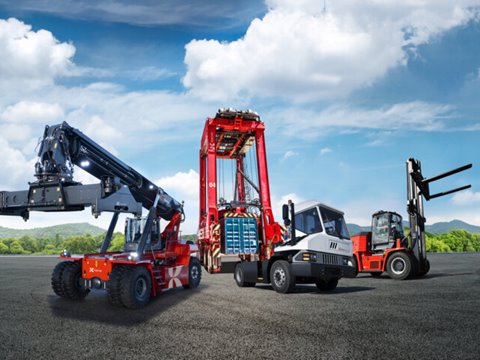
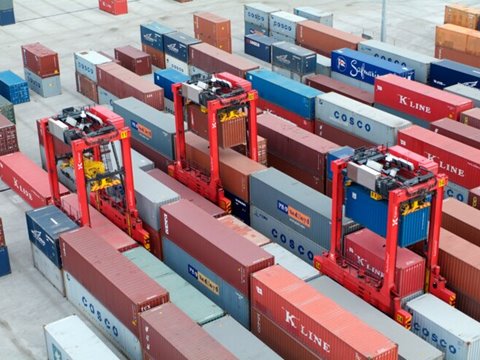
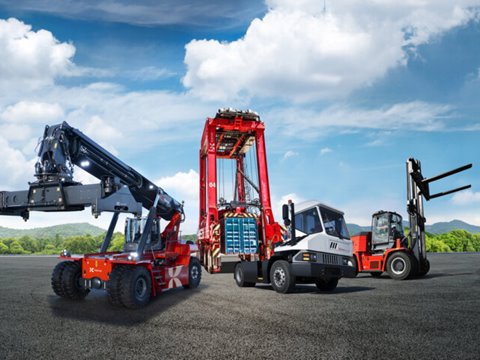
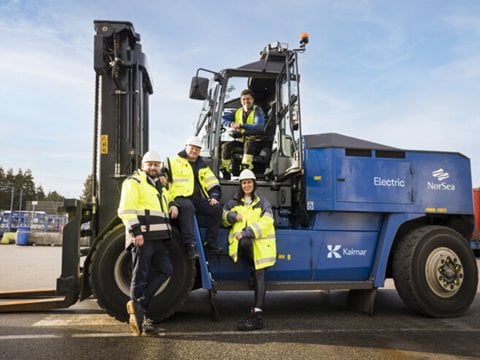
Electrification is the fastest and most effective lever today. Battery-electric straddle carriers, reachstackers, forklifts, terminal tractors and shuttle carriers are already technically viable and commercially available. For customers with sufficient charging infrastructure and renewable power access, they can eliminate local emissions and drastically reduce lifecycle carbon.
Hybridisation is a powerful interim solution for customers not yet ready to go fully electric. Kalmar’s hybrid straddle carriers, for example, can deliver 30–40% fuel savings compared to conventional diesel units while reducing noise and local pollution. - Digital optimisation
Energy efficiency is often overlooked but has enormous potential. Intelligent machine and fleet management, remote monitoring, and predictive maintenance can cut idle time, reduce unnecessary moves, and extend equipment life. Every tonne of CO2 avoided through efficiency is a tonne saved. - Hydrogen and alternative fuels
In certain heavy-duty applications, especially where operational cycles demand long running hours, hydrogen and alternative fuels may play an important role. As infrastructure and supply chains for green hydrogen and e-fuels develop, OEMs must be ready with flexible platforms capable of adapting to multiple fuel pathways. - Circularity
A significant part of decarbonisation lies in using resources more intelligently. Extending the life of existing equipment through refurbishment and modular upgrades reduces the need for virgin material production, especially carbon-intensive steel. Designing for recyclability and embracing remanufacturing are critical steps in lowering embedded emissions across the equipment lifecycle. - Energy efficiency
Transitioning to electric power is a massive leap forward, but it isn’t a "get out of jail free" card for energy consumption. Even with a zero-emission fleet, efficiency remains the backbone of a viable decarbonization strategy as infrastructure often struggles to keep pace with rapid electrification. In many regions, grid capacity is stretched thin, and the supply of truly "green" electricity remains a finite resource. Furthermore, efficiency is directly proportional to the bottom line. Reducing the kilowatt-hours required per container move translates immediately into lower overhead.
Thinking beyond the machine
A single electric reachstacker cannot decarbonise a port, terminal or distribution center. Real impact comes when the entire port ecosystem is optimised. That means aligning energy infrastructure, digital systems, and operational practices.
This is where OEMs can add real value as conveners. By working with e.g. port authorities, energy providers, and shipping lines, we can ensure that equipment decisions are not made in isolation but in harmony with wider decarbonisation strategies. For example, electrified fleets are only as green as the electricity they consume. Partnerships to secure renewable energy supply, charging solutions, and grid integration are just as important as the equipment itself.
Policy and collaboration
Decarbonisation cannot be left to technology or operators alone. Public-private collaboration is essential. Policy frameworks like the EU Emissions Trading System expansion and the International Maritime Organization’s decarbonisation strategy are raising the bar for ports globally. However, many operators, especially in emerging markets, need supportive financing and incentives to make the transition feasible.
OEMs can advocate for these frameworks while also innovating business models that lower the barriers to adoption. Leasing schemes, pay-per-use models, and service-based approaches can make zero-emission equipment more accessible.
No quick or easy fix
True thought leadership in this space requires honesty: there is no quick or easy fix. Decarbonisation will require upfront investment, systemic collaboration, and persistence in the face of uncertainty.
For Kalmar, this leadership means:
- Investing heavily in R&D to bring scalable, low-carbon solutions to market.
- Being transparent about the carbon footprint of our products, including Scope 3 supply chain emissions.
- Working with suppliers to decarbonise materials like steel and batteries.
- Partnering with customers to align technology roadmaps with their sustainability strategies and help with the electrification transition.
Conclusion: OEMs as catalysts of change
Decarbonisation in ports is not a distant ambition; it is a present necessity. OEMs have both the responsibility and the ability to accelerate progress. By innovating in technology, collaborating across ecosystems, and advocating for supportive policy, Kalmar can help ensure that the cargo-handling industry is not just a participant in the transition to net zero, but a leader of it.
The next decade will define the future of logistics. As an OEM, Kalmar is determined to be part of the solution — enabling ports around the world to operate more sustainably, efficiently, and responsibly.
About the author

Related articles
Subscribe and receive updates in your email
Subscribe